Sunday, October 9, 2011

Pottt's spine with bilateral psoas abscess - MRI


Sagittal T2 and T1 images of MRI lumbar spine in 20 year old male showing partial collapse of the L4 vertebral body with restropulsion of the posterior fragment causing thecal sac compression and mild compression on the traversing nerve roots. 

Axial T2 image at the level of L4 showing bilateral large psoas abscesses.
Coronal image well depict the craniocaudal extent of the abscess.

Lipoma Arborescens of the Knee - MRI

Sagittal T1 weighted MRI in 27 year old male shows a large suprapatellar effusion with a frond-like synovial mass of fat intensity in suprapatellar region and in posterior intercondylar region (arrows).
Sagittal PD FS MRI shows the synovial mass to be the same low intensity as fat (arrows).

Axial gradient echo MRI shows the characteristic frond-like pattern.


Discussion:
Lipoma arborescens is a rare benign lesion, which arises in the synovium and is characterized by villous proliferation of fat cells. The proliferating cells appear organic and often resemble a tree thus its name, arborescens, from the Latin arbor for tree.

Cause: is uncertain. One hypothesis is - synovial hyper-proliferation is in response to traumatic or inflammatory stimuli.
Associations: Trauma, osteoarthritis or rheumatoid arthritis.

Radiograph: Findings are non specific.
1. Soft tissue density with areas of lucency suggesting fat.
2. Underlying degenerative changes of the knee.

MRI: is the investigation of choice.
  • Villous proliferation, often with a frond-like configuration, which arises from within the synovial cavity.
  • Fatty characteristics and typical pattern of proliferation shows isointense to the fat on all the sequences.
  • Joint effusion.
  • Meniscal  tears.
  • Baker's cyst in 38%.

Intralobar sequestration - CT Angiography.

31 year old male patient came with repeated respiratory tract infections. CT showed consolidation in right lower lobe. Mediastinal window images show suspicious small artery supplying the lesion from the descending thoracic aorta for which CT angio was done


CT angio MIP and VRT images showing large single artery supplying the sequestrated segment of the lung. Venous drainage to the pulmonary veins. Later patient was taken for angioembolization of aberrant artery.

Discussion:

Definition: An aberrant lung tissue mass that has no normal connection with the bronchial tree or with the pulmonary arteries. 
Arterial blood supply: Systemic arteries, usually the thoracic or abdominal aorta.
Venous drainage: Azygous system, the pulmonary veins, or the inferior vena cava.

Two types:  
1. Intralobar sequestrations: can manifest as an area of increased opacity simulating pneumonia, as a mass with or without air-fluid levels, or as cysts. 
2. Extralobar sequestration, in which the sequestered lung has its own separate pleural covering, is much less common and usually is found on the left side next to the hemidiaphragm. At radiography, it may manifest as a reasonably well-defined mass at the base of the left hemithorax. Rarely, an intralobar and extralobar sequestration may occur in the same patient.
The main differentiating points are as given in the following table.


Thursday, October 6, 2011

Scapholunate ligament tear - MRI

Radiograph of wrist in 45 Year old male patient with pain in the wrist joint showing widened scapholunate joint space with focal periosteal elevation in the lunate (arrow).

Coronal PD FS image showing complete tear in the scapholunate ligament with mild marrow edema in the scaphoid and lunate bones.

Coronal GRE image well depicts the ligament tear (arrow).
Discussion:

  • Most common and most significant ligament injury of wrist causing carpal instability.
  • Risk factors: ulna minus configuation, slope of radial articular surface, and lunotriquetral coalition.
Spectrum of injury include: (increasing severity)
1. Dynamic scapholunate instability
  • No radiographic evidence of malalignment is present (ie dynamic deformity); 
  • Diagnosis is established by dorsal S-L tenderness and positive shift test; 
2. Rotatory subluxation of scaphoid:
3. Scapholunate dissociation (SLD):

  • SL ligament tear may lead to rotational dislocation of scaphoid allowing proximal pole to displace posteriorly & distal pole to displace anteriorly.
  • Scaphoid inherently tends to palmar flex because of its oblique position and the loading applied through (STT) joint.
  • Because scaphoid lacks proximal of ligament, it will rotate around radiocaptitate ligament leading to dorsal rotary subluxation of the proximal pole.
4. Dorsal intercalated segment instability: (DISI) 
5. Scapholunate advanced collapse:

Osteosarcoma of femur - Radiograph and MRI

Radiograph of 20 year old female showing destructive lytic lesion involving the metaphysis of the medial aspect of femur with new bone formation and periosteal reaction (caudman triangle) {Arrow}

T1 weighted coronal image showing lytic destructive lesion with soft tissue, periosteal reaction and new bone formation.

Axial GRE image showing the new bone formation as hypointense signal and periosteal reaction as hyperintense signals.

Coronal STIR image showing the lesion.
Discussion: Osteosacroma is malignant tumor of bone in which neoplastic osteoid is produced by a proliferating spindle cell stroma.

  • Most common primary malignant bone tumor of mesenchymal derivation.
  • Arises in adolescents, and second or third decade.
  • Affects males slightly more often than females. 

Affected sites:
  • Occurs in region of knee (distal femur or proximal tibia) in 50% of patients. 
  • Other sites include proximal humerus, proximal femur, & pelvis.
  • Most osteosarcomas occur in the metaphysis.
  • Infrequently occurs in the spine.
Classification:
  1. Classic 
  2. Telangiectatic 
  3. Parosteal 
  4. Periosteal
IMAGING:
Radiograph:
  • Destructive lytic lesion or mixture of lytic and sclerotic areas (common).
  • Moth eaten appearance with ill-defined zone of demarcation.
  • Involves the metaphysis
  • New bone formation.
  • Periosteal reaction
  • Visible soft-tissue mass.
  • Spiculated / Sunburst appearance.
  • 'Codman's Triangle' which is basically a subperiosteal lesion formed when the periosteum is raised due to the tumor.
CT Scan:
  • Gives clearer indication of bone destruction.
  • May depict small amounts of mineralized osseous matrix not seen on radiographs. 
  • May be particularly helpful in visualizing flat bones, in which periosteal changes may be more difficult to appreciate.
MRI:
  • Modality of choice in evaluating the local extent of disease because of its excellent bone marrow and soft tissue contrast and multiplanar capabilities.
  • it assists in determining the most appropriate surgical management.
  • Better delineates the involvement of the epiphysis, adjacent joint, adjacent soft tissues, neurovascular bundle, marrow extent and skip lesions.
Bone Scans:
  • Increased uptake of radioisotope on bone scans obtained by use of technetium-99m (99m Tc) methylene diphosphonate (MDP).
  • most useful in excluding multifocal disease but skip lesions are more reliable on MRI.

Wednesday, October 5, 2011

Giant Cell Tumor of Fibular head - Radiograph and MRI.

Radiograph of the knee in 32 year old male patient showing well defined expansile lytic lesion seen in the  epimetaphyseal region of fibular head with thinning of the cortex and cortical break at few places.

Axial T2 FS image at the level of fibular head showing expansile lytic lesion showing fluid contents with septations, thinning of the cortex and cortical break at few places. No obvious blood fluid levels noted.

Axial T1 weighted image at the level of fibular head showing the lesion with isointense contents and thinning of the cortex.

Coronal T1 weighted images showing the lesion.
Discussion:
  • GCT is a common benign but locally aggressive lesion of unknown etiology. 
  • It occurs chiefly in men between 20-50 yrs (after epiphyseal closure).
  • The tumor is expansile lytic lesion that involves the epiphysis & metaphysis.
  • The tumor may enlarge to occupy most of epiphysis & adjacent metaphysis. 
  • The tumor may erode & penetrate subchondral bone, articular cartilage, & cruciate ligaments.
Location:

  • Epiphysis of distal femur, proximal tibia, & distal radius.
  • Other sites: fibula, sacrum, proximal humerus, & distal tibia.
  • Can occur in bones of pelvis, particularly ilium near SI joint and sacrum.
Spine:
  • Usually located in vertebral body; 
  • Radiolucent lesion in vertebral body of a young patient is likely to be GCT; 
Staging:
Stage I:
  • Benign latent giant cell tumors.
  • No local aggressive activity.
Stage II:
  • Benign active GCT. 
  • Imaging studies demonstrate alteration of the cortical bone structure.
Stage III:
  • Locally aggressive tumors.
  • Imaging studies demonstrate a lytic lesion surrounding medullary and cortical bone.
  • There may be indication of tumor penetration through the cortex into the soft tissues.
IMAGING:
Radiographic Features: well-defined lytic lesion that involves the metaphysis and epiphysis (typical of a giant cell tumor);

CT Scan: helps to determine the extact amount of cortical destruction and helps determine the optimal location of the cortical window;

Bone Scans: Bone scans may show decreased radioisotope uptake in the center of lesion (doughnut sign). It is also found in ABC.

MRI:
  • MRI May show fluid fluid or blood fluid levels.
  • Help determine determine extent of tumor destruction and soft tissue involvement.
  • May be indicated when the tumor has eroded through the cortex and allows determination of whether concomitant neurovascular structures are involved.
  • May help evaluate subchondral penetration.
Differential diagnosis:
1. Aneurysmal bone cyst - ABC.
2. Non Ossifying fibroma.

Wednesday, September 28, 2011

Supraspinatus avulsion tear - MRI

Proton density oblique coronal MR image in 41 year old male patient with trauma showing focal fracture in the greater tuberosity of the humerus (arrow head) with full thickness tear in the supraspinatus tendon and retraction of the tendon fibers (arrow) suggestive of full thickness avulsion tear.

T1 TSE oblique coronal MR image showing focal fracture in the greater tuberosity of the humerus (arrow head) with absent hypointense  supraspinatus tendon.

Axial T2 Medic (GRE) image showing fracture and tendon tear.

Sagittal STIR image showing full thickness tear and absent tendon fibers.

Discussion:
  • Full-thickness avulsion tears of the tendon away from the greater tuberosity are less common.
  • Massive tears often extend posteriorly to involve the infraspinatus tendon or extend anterior to tear, the anterior interval and subscapularis tendon.
  • If an acute complete supraspinatus tendon tear is identified, surgery is often scheduled within the next several days so that the tendon can be repaired before the development of retraction or atrophy.
  • Angled oblique sagittal T2/STIR images perpendicular to the plane of the supraspinatus tendon can better delineate the partial and full thickness tears.

Tuesday, September 27, 2011

Calvarial thickening - MRI

T1 weighted axial image in 24 year old female with thalasemia showing diffuse thickening of the calvarium.

T2 weighted axial image showing calvarial thickening.

FLAIR axial image showing calvarial thickening.

Discussion:
Differential diagnosis of calvarial thickening:
  1. Various severe anemias - bone marrow expansion.
  2. Pagets disease.
  3. Hyperparathyroidism.
  4. Osteopetrosis.
  5. Chronic Dilatin therapy.
  6. Acromegaly.
  7. Some rare genetic diseases - Camurati-Engelmann’s disease, frontometaphyseal dysplasia and   craniodiaphysial dysplasia.

Traumatic optic nerve compression - CT

Axial CT section through the optic nerves in a 59 year old male with trauma showing fracture in the posterior part of the lateral wall of the right orbit and the fracture fragment is causing compression on the optic nerve at the optic canal (arrow) and note the normal wide optic canal on left side (arrow head).

Coronal CT scan bone window showing the bony fragment compressing the optic nerve and narrowing the optic foramen (arrow) and note the normal foramen on left side (arrow head).

Sagittal image showing the bony fragment compressing on the optic nerve.
Discussion:
  • Traumatic optic neuropathy is a devastating potential complication of closed head injury.
  • The hallmark of an optic neuropathy, traumatic or otherwise, is a loss of visual function, which can manifest by subnormal visual acuity, visual field loss, or color vision dysfunction.
  • Vision loss associated with traumatic optic neuropathy can be partial or complete and temporary or permanent.
  • Best diagnostic test is Thin-slice CT scan of the nose, sinuses, and orbits
  • Fractures through the optic canal can be best depicted with thin-section CT scanning (eg, 1.5-mm cuts with 1-mm intervals).
  • CT scanning provides adequate imaging of orbital soft tissue and is better than MRI at delineating bony defects. 
  • It provides an intraoperative road map for the surgeon in patients who require surgical decompression and can be used for image guided endoscopic surgery.
  • Treatment is observation, steroids and optic nerve decompression. The decision for surgical decompression should still be based primarily on the clinical examination findings.

Cystosarcoma phyllodes tumor

Film screen mammogram of the right breast in 41 year old female showing large well defined dense lesion with smooth margins. No calcification. 


USG of the same patient showing heteroechoic mass lesion with well defined smooth margins. The lesion shows width>breadth. No evidence of calcification.

Discussion:
Cystosarcoma phylloides is a rare breast tumor that accounts for approximately 0.5% of breast tumors examined at biopsy and approximately 2.5% of-fibroid epithelial tumors examined at biopsy. This tumor was named in 1838 by Johannes Muller, who described large firm tumors of the breast. He believed the tumor to be benign and observed that the surface had a leaf-like (phylloide) configuration and contained narrow cyst-like spaces within a sarcoma- like stroma.

It was not until 1943 that Cooper and Ackerman reported on the malignant biological potential of this tumor. Clinically, patients present with a palpable breast mass. Although periods of rapid growth are known to occur, the mass usually develops slowly. The lesion is mobile, not fixed to the skin or the chest wall. Although the lesions have occasionally been noted in both breasts, they are usually found only in one. They have been reported to occur in patients of any age, although the average age is 40 to 45 years.

Mammogram usually shows well defined mass lesion of varying sizes, predominantly large mass. The lesion shows smooth margins in benign and irregular margins in malignant lesion. There may or may not have macrocalcification. USG shows solid mass lesion within the breast and shows a defined margins and some small fluid filled clefts with in the lesion may be diagnostic of cystosarcoma phylloides.

Sunday, September 11, 2011

Usual Interstitial Pneumonia with Tuberculosis - HRCT

Radiograph (scanogram)  of 81 year old male with dyspnea showing reticular opacities, fibrotic bands, honey coombing and few fibrocavitatory lesions in bilateral upper lobes consistent with UIP with old Tuberculosis.


HRCT of 81 Year old female showing macrocystic honeycombing and reticular
opacities predominantly in the subpleural region.

HRCT along the upper lobes showing fibrocavitatory lesions

Coronal lung window showing reticular shadows and honey combing predominantly in the basal region with fibrocavitatory lesion in upper lobes.

Usual Interstitial Pneumonia - HRCT

HRCT of 40 Year old female showing macrocystic honeycombing, reticular
opacities predominantly in the subpleural region, architectural distortion and
areas of focal ground-glass opacity 

Mediastinal window of the same patient showing small enlarged pre tracheal lymphnode.

Discussion:

Idiopathic Pulmonary Fibrosis (IPF) is the most common entity of the Idiopathic Interstitial Pneumonias (IIPs). By definition, IPF is the term for the clinical syndrome associated with the morphologic pattern of UIP.
Median survival - 2 to 4 years.

Clinical features - Presents in 50 years old or older. Patients present with progressively worsening
dyspnea and nonproductive cough.

Histopathologic Features: Spatial and temporal heterogeneity, architectural distortion and fibroblastic foci.

HRCT: Distribution is apicobasal gradient and predomonently subpleural location. 
Features are macrocystic honeycombing, reticular opacities, traction bronchiectasis, architectural distortion and focal ground-glass opacity.

Saturday, September 10, 2011

Temporal bone fracture with facial nerve injury - HRCT

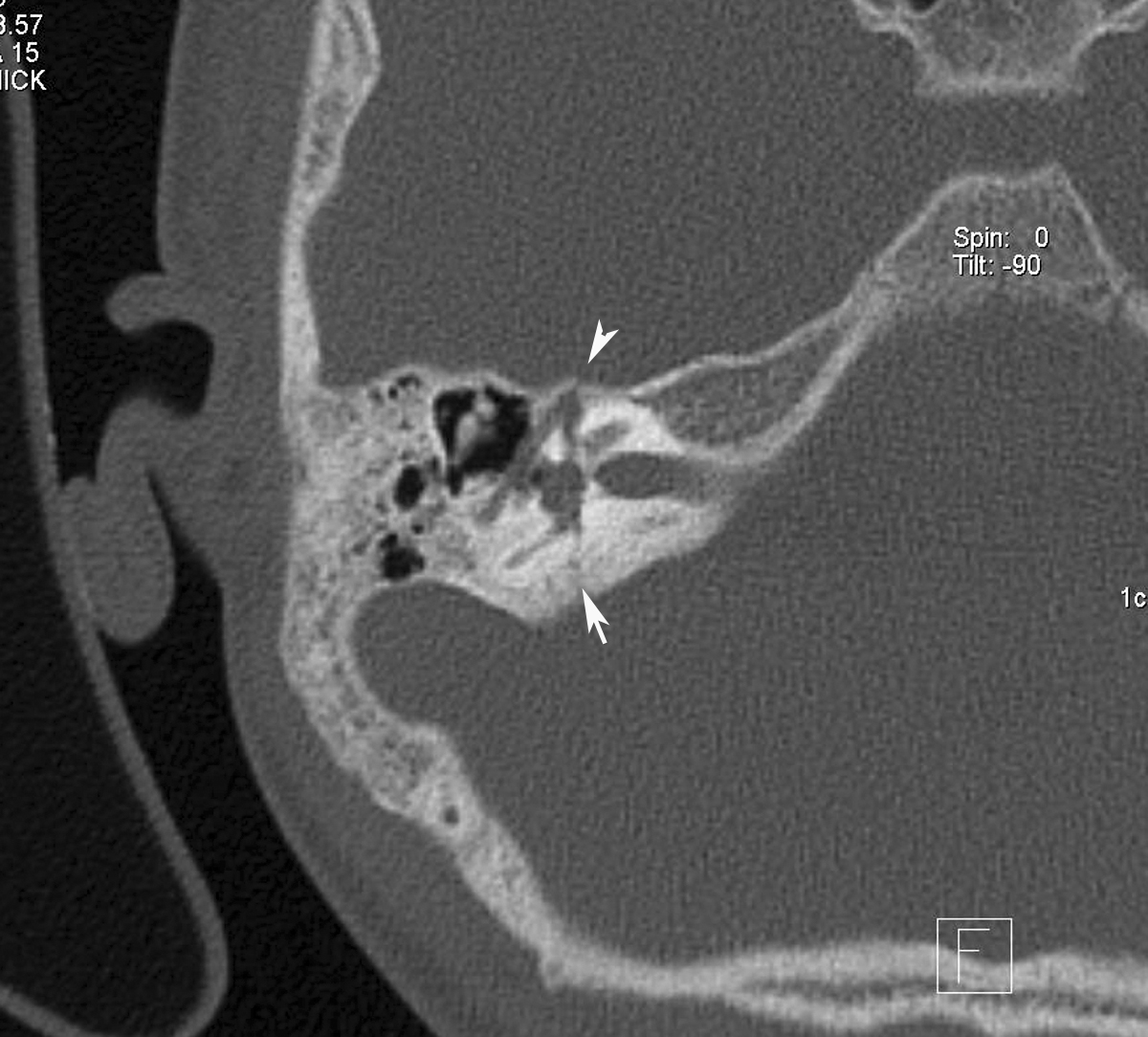
HRCT of right temporal bone axial image showing transverse temporal bone fracture (arrow) and the fracture line passing through the first anterior genu of the facial nerve canal (arrow head).

Subsequent section of the HRCT right temporal bone showing the fracture passing through the facial nerve canal (arrow head).

Discussion: Temporal bone fractures classically are described with reference to the long axis of the petrous bone.
Classification:
1. Longitudinal (parallel to the axis).
2. Transverse (perpendicular to the axis).
3. Oblique/Mixed- Common.


Longitudinal fracture: The fracture line of force runs roughly from lateral to medial. A fracture line may extend through the facial nerve canal, thereby damaging the facial nerve. Associated injury, such as transection or intraneural hemorrhage, may cause facial nerve paralysis, as can damage from displaced bone fragments.


Transverse fracture: result from trauma to the occiput or cranial-cervical junction, with the line of force running roughly anterior to posterior.A fracture passing through the vestibulocochlear apparatus can cause sensorineural hearing loss and equilibrium disorders. Transverse fractures also commonly injure CN VII, because their path often takes them close to the nerve's labyrinthine segment.

Mixed fractures: Oblique (or mixed) fracture patterns, which extend both longitudinally and transversely, are common, and some case series report that these occur more often than do isolated transverse or longitudinal fractures.

Radiology:
Radiography: Plain film radiographs of the skull may show opacified mastoid air cells, intracranial air, or, rarely, a lucency (fracture line).

HRCT: can demonstrate a lucency through the temporal bone. Involvement of the middle ear, petrous bone, otic capsule, and facial nerve canal are the primary determinants of prognosis.


MRI: may demonstrate fluid (high signal on T2-weighted images) in the middle ear and mastoid air cells. T1-weighted images may reveal a bright signal in the labyrinth or middle ear, consistent with hemorrhage.

Splenic Artery Aneurysm in Extrahepatic Portal Vein Obstruction - CT Angio

Axial thick MIP image of CT angiography showing aneurysm arising from the main splenic artery

Coronal thick MIP image of CT angiography showing aneurysm arising from the main splenic artery

3 D volume rendering image of CT angiography showing aneurysm arising from the main splenic artery (arrow).

Axial CT image in venous phase showing multiple collateral veins in the porta with non visualised main portal vein consistent with extra heaptic portal vein obstruction. Note splenomegaly and multiple leinorenal collaterals.

Discussion:

Splenic artery aneurysms (SAA) are the most common visceral aneurysm occuring predominantly in females. SAA causing EHPVO and presenting with features of portal hypertension is extremely rare.
Women are affected four times more commonly by SAA and often during pregnancy and childbearing years due to endocrine changes.
The usual location of splenic artery aneurysm is at the mid or distal portion of the splenic artery, frequently found at the arterial bifurcation.

Clinical features: They are usually asymptomatic, and the symptomatic presentation includes chronic abdominal pain of varied severity or an acute rupture with hypotension.

Radiology:
CT angiography is the best modality for the diagnosis, although it is usually detected incidentally.

Treatment:
Endovascular: Coiling or covered stent.
Operative: Aneursyectomy with or without splenectomy.

Friday, September 9, 2011

Tracheal Foreign Body - CT Scan with 3D.

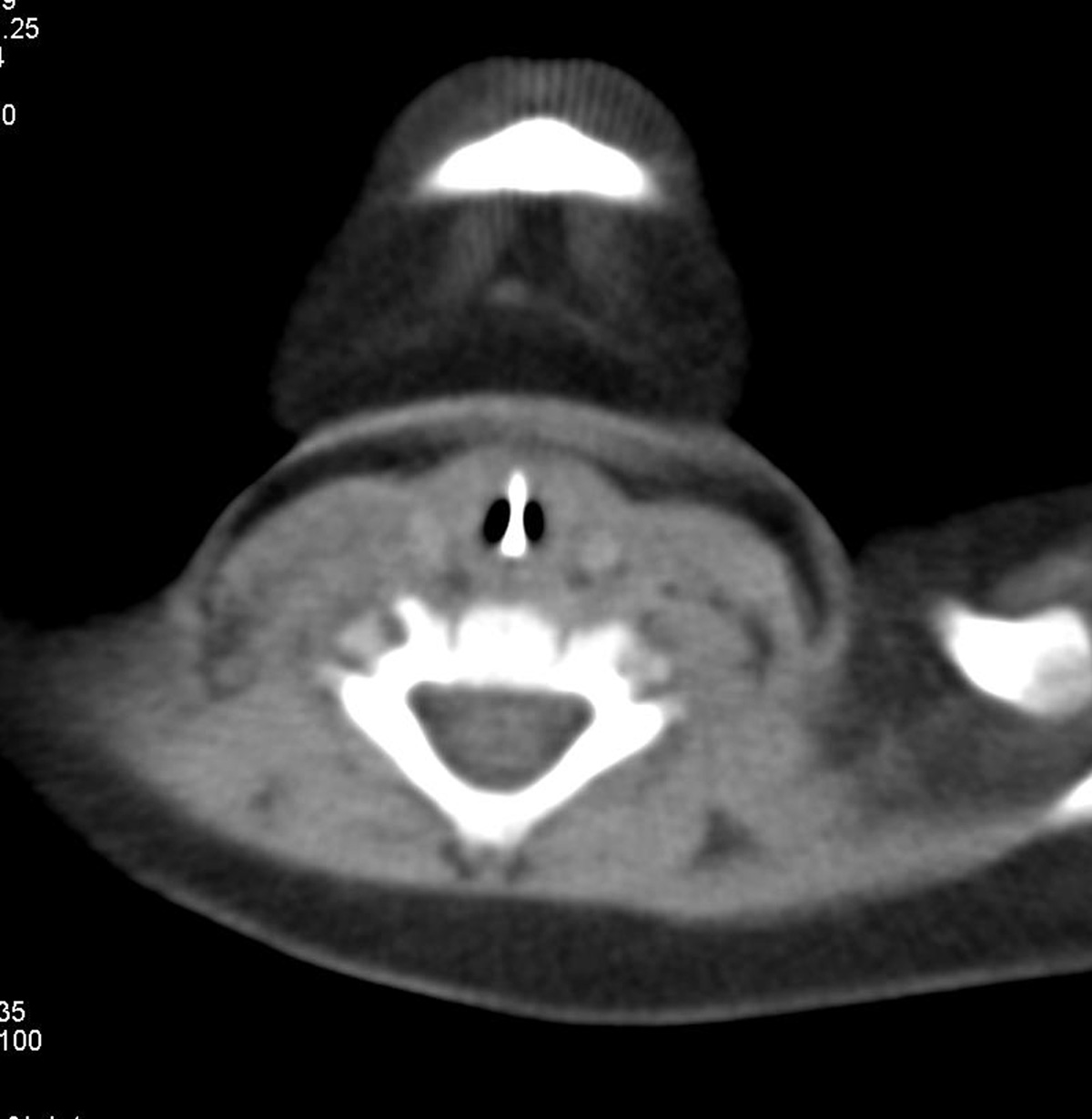
CT scan axial soft tissue window of 7 Months old male child with history of foreign body aspiration with asymptomatic baby showing linier metallic foreign body oriented vertically in the center with patent lumen on either side. 

Coronal reformatted CT scan soft tissue window well delineate the vertical extent of the foreign body

Minimum intensity projection (minIP) image showing the foreign body. 

3D Volume rendered image showing showing the foreign body. 

Virtual bronchoscopy showing showing the foreign body (arrow). 

Extraction by bronchoscopy is the treatment of choice for tracheal foreign bodies

Search This Blog